
REVIEW · HOI AN ANCIENT TOWN TOURS
Hoian Old Town – Immersive Free Walking Tour
Hoi An’s UNESCO streets are made for walking. This free, small-group tour is a tight, 2 hour way to connect the town’s architecture with the real trading history that shaped it. I like that you get main landmarks plus local explanations, not just photo stops. I also like that you’ll end with Hoi An Central Market so you can keep your bearings for the rest of your trip.
You’ll start near 125 Phan Chu Trinh and move through Hoi An’s old town with an English speaking guide (Quoc Le), covering the Japanese Covered Bridge Pagoda, major assembly halls, and standout historic houses like the Phung Hung Ancient House. The tone is friendly and interactive, with a local storyteller feel rather than a lecture.
The main drawback to plan for is the UNESCO part. You’ll need an entrance ticket for UNESCO sites, priced at $5 (120,000 VND) per ticket, and that is not included. Also, the tour runs rain or shine, so you’ll want comfortable, weather-ready clothes.
Key highlights worth your time

- Japanese Covered Bridge Pagoda: a quick stop with big meaning in Hoi An’s trade story
- Tan Ky old house: lived-in looking heritage that helps you picture the past
- Hoi An Traditional Art Performance Theatre: about 45 minutes of music and dance to connect culture to place
- Assembly halls (Cantonese and Fujian): community buildings that show how different groups shaped the town
- Phung Hung Ancient House: one of the best historic house stops for atmosphere
- Hoi An Central Market finish: a practical ending point for seafood and local life
Thirty minutes down the coast, more of the Ancient Town
- Hoi An: Basket Boat Ride in the Coconut Forest
★ 4.9 · 4,956 reviews - Hoi An: Vietnamese Coffee Culture and Coffee Making Class
★ 4.9 · 4,006 reviews - Hoi An: Vietnamese Foldable Lantern Making Class
★ 4.9 · 3,742 reviews - Cooking Class Hoi An:Local Market, Basket Boat, Fishing & Cooking
★ 5.0 · 3,660 reviews
Why walking the UNESCO core is the smart move
Hoi An feels different when you move at human speed. The UNESCO core is all close together, and most of the magic is in how streets, shopfronts, and old houses stack up next to each other. A walk tour helps you do the important thing first: get oriented. You start to recognize the geometry of the town, the way waterways and lanes guide movement, and why certain landmarks were so visible to merchants.
I also like that the tour is built around stories. Since Hoi An became a busy trading port back in the 16th century, the town’s look is not random. You see it in the shared influences from Chinese, Japanese, Portuguese, and European traders. When a guide points out what you are seeing, the sights stop being just pretty and start making sense.
One more practical reason this works: it is a great fit for a short stay. Not everyone has a full day to burn on sightseeing. Two hours is enough time to see key anchors, then keep exploring on your own with better context.
Meeting at 125 Phan Chu Trinh, then letting Quoc Le steer
The meeting point is 125 Phan Chu Trinh. The guide, Quoc Le, will be wearing a white T-shirt with a shoulder bag, which makes it easier to spot the group quickly.
This format matters because small groups change the feel of a walk. The group is limited to 5 participants, so you are less likely to get lost in the crowd. It also makes Q&A more natural when you want clarification on something you see, like an old house layout or why an assembly hall is where it is.
English-language guiding is another real value point. Hoi An has a lot of layered history, and the difference between a basic sign explanation and a clear, spoken story is huge. With an English-speaking local guide, you can ask the simple questions that make the whole town click.
If you join soon after arriving, you also get advantage tips for what to do next. The tour is timed to help you understand the town fast, then spend the rest of your trip exploring smarter.
Japanese Covered Bridge Pagoda: a quick stop that pays off
The tour begins with a visit to the Japanese Covered Bridge Pagoda. Expect about 10 minutes here. That sounds short, but it is usually enough time to appreciate what makes this bridge special and to understand why it still draws people in.
What I like about this kind of stop is that it creates an instant mental reference point. When you come back later on your own, you notice the surrounding details differently because you understand the context. Even if you only spend a short moment at the bridge itself, it helps you connect the rest of the walk to the town’s trading connections and cultural mix.
Also, covered bridges in old towns are not just cute. They are functional, sheltered, and tied to community movement. The guide’s explanation helps you look beyond aesthetics, so you see how people used these spaces in daily life.
Pro tip: plan to bring your patience for photo angles. The bridge is a popular landmark, and you may need a moment to step aside for clearer views.
Walking the Ancient Town other ways
- Hoi An Ancient Town Walking Tour with a Local★ 5.0 · 517 reviews
- The Lantern Lady: Traditional Lantern Class in Old Town★ 4.9 · 444 reviews
- Hoi An Ancient Town – Walking Tour with Local Guide★ 4.9 · 385 reviews
- Hoi An Night Market – Ancient Town street food tours by Night★ 5.0 · 165 reviews
- Hoi An Ancient Town – Night Market Street Food Tours By Night★ 4.5 · 161 reviews
Old House of Tan Ky: how to read heritage without overthinking
After the bridge, you head to the Old House of Tan Ky for another 10 minutes. This is the kind of stop that can be either a quick glance or a memorable window into daily life, depending on how you approach it.
Here’s the best way to use your time: focus on how the house connects to the street. Look at the front space, then notice how the structure implies movement inward. The goal is not to become an architecture expert. The goal is to picture what household routines might have looked like when the town was thriving as a trading port.
I like that the tour keeps pushing you to connect what you see with what happened here historically. Hoi An’s old houses are part of why the UNESCO designation feels real. You are not just seeing monuments, you are seeing built environments that show how generations lived.
If you are the type who loves details, you will likely get more out of this house stop because the guide’s local storytelling tends to point out small things you might miss on your own.
Theatre time: traditional art performance that explains the culture
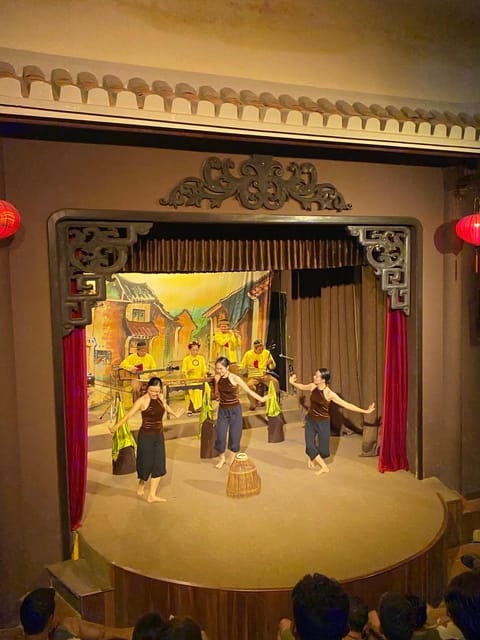
One of the most valuable parts of the tour is the time at the Hoi An Traditional Art Performance Theatre. You spend about 45 minutes here, with a concert and dance show.
This is not filler. It is a cultural translation tool. When you watch traditional performance arts, you start to understand what historical influences feel like in practice, not just in architecture. It also breaks the walking rhythm at exactly the right time, which helps if the morning sun or afternoon heat makes you move slower.
I find that theatre segments make a walking tour stronger because they give you a sensory memory to attach to the old town. Later, when you walk past assembly halls or historic houses, you are not only thinking of the past. You are also thinking of how culture lived alongside trade.
Practical note: wear comfortable clothes. You will be standing, moving, and waiting at certain points during the show process, even if the performance itself is seated.
Cantonese and Fujian assembly halls: community power in stone
Next up are the assembly halls, including the Fujian Assembly Hall and a stop connected with the Cantonese Assembly Hall. Each stop is short, about 10 minutes for the Fujian hall based on the schedule, but the payoff is in what these buildings represent.
Assembly halls were community hubs. They reflected how different groups organized themselves in a trading port. So when you see one, you should think beyond decoration. Ask yourself: Who used this building? Why would people gather here? How does the location fit the town’s movement?
The guide’s local stories help you see these halls as social infrastructure, not just heritage architecture. That makes the time feel worthwhile even if you are moving quickly through the old town.
If you love history that feels human, assembly halls are usually a high point. They show how identity formed in a multi-cultural place.
Phung Hung Ancient House, Kazik Park, and the performance area
After the assembly halls, the walk continues through more of the UNESCO core character. You will get stops tied to Phung Hung Ancient House, the Performance Art Center, and Kazik Park.
Even though Kazik Park sounds like a simpler stop, I think it is a smart inclusion. You need a pause in an old town walk. A short breather helps you reset before the final stretch, and it gives your eyes time to adjust from tight streets and ornate building fronts.
The Phung Hung Ancient House stop is a highlight for many people because historic houses in Hoi An feel close to the ground. They look lived-in and human-scale, which makes them easier to imagine being part of real daily life, not just preserved for tourists.
The Performance Art Center stop also keeps the culture thread going. If the theatre show planted the first seed, these final stops help you connect what you saw on stage to what you experience in the town’s atmosphere.
Take your time with these sections. The best old town photos are often the ones where you step back for a second and notice the relationship between buildings, street textures, and the direction people are naturally walking.
Hoi An Central Market finish: seafood sights and what to do next
The tour ends at Hoi An Market, giving you a practical finish point. Markets are where old town life feels most immediate, and in Hoi An that includes seafood specialties.
Even if you do not plan to eat during the tour, you will likely benefit from knowing what is available and what locals buy. That can shape your next meal choices when you’re hungry later.
I also like using a market as a final stop because it helps you move on smoothly. Instead of feeling done and wandering randomly, you end in a place that is useful for real decisions: where to buy water, where to grab a snack, and how to keep moving around safely.
If you want to keep the day flowing, use the market area to plan your next direction. You will have a much easier time spotting the routes between landmarks once your brain already has the landmarks from the walk.
Price, UNESCO tickets, and how to budget for a fair total
The tour price is $10 per person for about 2 hours with an English speaking guide and a small group size capped at 5 participants. On top of that, UNESCO sites require an entrance ticket priced at $5 (120,000 VND) per ticket. The important part is that UNESCO access cost is not included.
So what does a realistic total look like? If you plan to enter the UNESCO attractions covered by the route, you should budget around $15 total for tour plus UNESCO ticket, before tipping.
Now add tipping. This is a tip based tour where you can pay what you feel is appropriate, and the guide provides guidance: 250,000 VND per person for nice and 300,000 VND to 400,000 VND per person for great.
I like that the tour makes the expectations clear. For value, what you are paying for is not only walking between places. You are paying for interpretation, local context, and an English-speaking guide who helps you understand what you see quickly, which is exactly what you want in a place as layered as Hoi An.
If you’re watching costs closely, the UNESCO ticket is your one fixed extra. Everything else, like tipping, is flexible based on how you felt the guide delivered.
Rain or shine, plus dress rules that affect comfort
This tour runs rain or shine, so treat it like a true walking plan rather than a casual weather-dependent stroll. Bring comfortable clothes and expect the day to move forward even if the sky changes.
Also note the clothing rules: loose clothing and see-through clothing are not allowed. This is not just about strictness. It is about comfort and respectful presentation in heritage areas and indoor spaces like the theatre.
Finally, it is not suitable for people over 95 years. If you are older or have mobility issues, this one might be too much walking time.
If you are travel-practical, this tour is a good match: small group, predictable duration, and a route that keeps you from wasting time figuring out where to go next.
Should you book this Hoi An Old Town walking tour?
I’d book it if you want a fast, organized introduction to Hoi An’s UNESCO core. The combination of landmark stops, assembly hall context, and a 45-minute traditional performance is a strong mix for building understanding without spending an entire day.
I’d skip it if you want a long, slow, deep exploration with tons of free time at each stop, or if you do not want to deal with the added $5 UNESCO ticket. Also, if you strongly dislike rain and cannot handle weather, keep in mind the tour runs anyway.
If it’s your first day in Hoi An, this tour is especially useful. You learn what to look for, then you can roam with confidence.
FAQ
How long is the Hoi An Old Town immersive free walking tour?
The tour lasts about 2 hours.
How much does the tour cost?
The price is $10 per person.
Do I need tickets for UNESCO attractions?
Yes. Ticket is needed to enter UNESCO attractions, priced at $5 (120,000 VND) per ticket.
Is the tour guided and in English?
Yes. It includes a live English-speaking tour guide.
What is the meeting point?
The meeting point is 125 Phan Chu Trinh. The guide will be wearing a white T-shirt with a shoulder bag.
How many people are in the group?
The group is small, limited to 5 participants.
Does the tour run in bad weather?
Yes. The tour operates rain or shine.
How does tipping work?
This is a tip based tour, so you can pay what you feel is appropriate. The guide’s guidance is 250,000 VND per person for nice, and 300,000 VND to 400,000 VND per person for great.
What should I wear or bring?
Wear comfortable clothes. Avoid loose clothing and see-through clothing.
More Tour Reviews in Hoi An


The Ancient Town, Other Walks


Hoi An, A Few More Ways
Just added around Hoi An



Hoi An Ancient Town Tours, compared.
 ★ 5.0Marble Mountains – Hoi An Ancient Town Sunset Daily Ingroup TourFrom $33690 reviews
 ★ 5.0Hoi An Ancient Town Walking Tour with a LocalFrom $9517 reviews
 ★ 4.9The Lantern Lady: Traditional Lantern Class in Old TownFrom $6444 reviews
 ★ 4.9Hoi An Ancient Town – Walking Tour with Local GuideFrom $14385 reviews
 ★ 4.8Hue Imperial Ancient City Walking TourFrom $2308 reviews
 ★ 5.0Linh Ung Pagoda – Marble Mountains – Hoi An Ancient Town Daily Ingroup TourFrom $39299 reviews
 ★ 5.0Hoi An Night Market – Ancient Town street food tours by NightFrom $45165 reviews
 ★ 4.5Marble Mountains – Hoi An Ancient Town Afternoon Tours FROM DANANG(15H30-21H)From $37162 reviews
Browse the lists this tour appears in