

REVIEW · MARBLE MOUNTAINS TOURS
Hue: Enchanting Marble Mountains And Hoi An’s Timeless Charm
Two stops, one unforgettable Central Vietnam day. This route strings together Marble Mountains and Hoi An Ancient Town, so you get big scenery plus a compact heritage walk without extra planning. I particularly love the climb through caves and pagodas at Ngu Hanh Son, and I also like how Hoi An feels preserved enough that you can actually read the centuries in the streets and buildings. The only real drawback to plan for is the amount of walking and steps at Marble Mountains, even with the included one-way elevator.
The morning starts with hotel pickup in Hue city center and an air-conditioned ride. You’ll have an English-speaking guide, bottled water, entrance fees, and lunch built into the day, which matters on a full 11-hour itinerary. And because the tour is listed as wheelchair accessible and offers private or small groups, it tends to feel less chaotic than big cattle-call buses.
I like that the day keeps moving but doesn’t feel like a frantic checklist. You’ll stop for a quick market browse, a stone carving visit at Nhựt Mạnh, and several heritage sites in Hoi An, including the iconic Japanese Covered Bridge. One consideration: on some days, the Japanese Covered Bridge area may be under renovation, so you may need to accept a shorter photo moment.
Key things I found most useful

- Marble Mountains, Ngu Hanh Son, meaning five elements mountains, plus caves and pagodas with big views.
- Hoi An Ancient Town on foot, with multiple short stops that fit a comfortable walking loop.
- Japanese Covered Bridge with its tile roof, one of the easiest sights to spot and one of the easiest to miss if it is closed for work.
- Fujian Assembly Hall and other Chinese-influenced architecture, where you can see history in details, not just photos.
- A stone-carving workshop at Cơ sở điêu khắc đá Nhựt Mạnh, so the marble story becomes craft, not just scenery.
- Lunch, a market stop, and local snacks, so you keep energy for the walking without hunting for food.
Thirty minutes down the coast, more of the Ancient Town
- Hue: Private Car to Hoi An via Fabulous Stops
★ 5.0 · 371 reviews - From Hue: Hoi An Bus Transfer with 4 Sightseeing Stops
★ 4.6 · 366 reviews - From Da Nang/Hoian/Hue: Hue Imperial City Full-Day Tour
★ 4.8 · 295 reviews - From Hue: Epic Coastline & Hidden Gems Tour to Hoi An
★ 4.7 · 134 reviews
From Hue To the Da Nang Coast: how the day stays manageable

Hue is a great base, but Hoi An and the Marble Mountains are far enough away that doing it alone can get messy fast. This tour solves that by taking you out of Hue by air-conditioned coach, with hotel pickup and drop-off in the city center. You’re on the move early, but you’re not stuck figuring out rides between stops.
The timing is built around two clusters. First you visit Marble Mountains and a nearby stone-carving stop, then you head into Hoi An for a walking heritage tour. When a day like this is well organized, it feels like you’re spending your time looking at places instead of solving transportation puzzles.
The guide being English-speaking is a quiet but important plus. You get explanations while you’re actually standing in front of the site, instead of trying to piece together meaning later from signs or your phone. That also helps if your group moves at a varied pace, because the story stays attached to what you’re seeing.
Marble Mountains caves and pagodas: five elements views you can work for
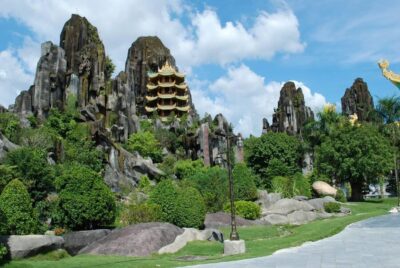
Marble Mountains, known in Vietnamese as Ngu Hanh Son (five elements mountains), is the kind of place that rewards effort. You’ll arrive, then climb numerous steps to reach caves and stone-carved pagodas. The included entrance fees cover access, so you can focus on the walk, not the ticket math.
What I like most here is the mix of natural rock and human-made detail. The caves feel mysterious because they are built for discovery, not just a straight hallway stroll. And the pagodas add that spiritual rhythm to the climb, where you pause, look up, then keep moving to the next viewpoint.
Expect panoramic views when you reach the right angles. Even if you don’t climb to the absolute highest points, you’ll still feel the change in elevation, and the surrounding area comes into focus. That matters for photos, but it also matters for your sense of place, because the site stops being just a viewpoint and starts feeling like a landmark.
There’s one more practical note. You get a one-way elevator included at Marble Mountains, but you may still do plenty of stairs. If you can climb steps comfortably, I think it’s worth considering skipping the elevator when it would cost you time in a line or planning bottleneck. If you need help managing stairs, use the elevator strategically.
Nhựt Mạnh stone carving stop: where the marble story turns into craft

After the main Marble Mountains visit, you’ll head to Cơ sở điêu khắc đá Nhựt Mạnh for a guided look. This stop is only about 30 minutes, so it’s not a long workshop class. But it gives you a useful context for what you saw at the mountains, because the stone carvings you noticed are part of a living craft culture.
I like these short “how it’s made” visits on heritage days because they prevent your brain from treating everything as frozen in time. Instead, you see that the same stone tradition still gets worked into objects and decorations. Even in a short visit, you can come away with a sharper eye for tool marks, textures, and how artisans shape stone.
Over the pass and into the imperial city
- Hue Customizable Tour with Imperial Citadel & Forbidden City★ 4.9 · 937 reviews
- Hue :Exploring Royal City with Multi Options and Dragon Boat★ 5.0 · 675 reviews
- Hue City Tour Full Day – Group Tour★ 4.7 · 518 reviews
- From Hue: DMZ Tour with Vinh Moc Tunnels and Khe Sanh Base★ 4.9 · 503 reviews
- Hue Imperial Ancient City Walking Tour★ 4.8 · 308 reviews
Hoi An Ancient Town walking loop: why this feels like the real deal

Hoi An Ancient Town is a UNESCO World Heritage Site, and the key word for you here is ancient plus compact. The walk is the point. You’ll do it with a guide, and the itinerary is structured so you hit the most important architecture without having to map every turn.
I like that the pace is a sequence of short stops rather than one giant museum sprint. You’ll spend time seeing historic streets, then rotate through cultural landmarks and old houses. Because the locations are close to each other, your legs do the work instead of the logistics.
The town’s cultural blend is not just a line on a brochure. You’ll see influences from Vietnam, China, Japan, and France reflected in the styles of buildings and assembly spaces. Standing in the street, you can pick up how shop-house shapes, rooflines, and ornament patterns suggest different eras and communities that once shared the port.
One bonus: Hoi An’s atmosphere is the kind that makes you slow down even when the schedule is moving. After a few stops, you start noticing small details like how doorways, courtyards, and street frontage shape daily life. That’s the part you can’t get from a bus window.
Hoi An Museum, market time, and the smart use of short breaks

In Hoi An, you’ll make several stops that change the tempo. A market visit is built in, and it’s timed to be short enough that it doesn’t derail the rest of your heritage walk. You’ll have a guided food market visit around 25 minutes, which I think is the ideal length for sampling without turning the day into a grocery errand.
This is a good moment to observe how locals actually eat and shop. Even if you skip buying anything, you’ll learn a lot from what’s displayed and how stallholders package everyday items. If you do buy something, keep it simple so you don’t end up carrying it while you climb through the next section of town.
You’ll also visit Hoi An folk museum for a brief guided stop. That kind of museum stop is useful because it gives you cultural background just before you hit the old houses and assembly hall spaces. When you later look at architecture, you can connect the dots more easily.
If you have motion sensitivity or tired legs, remember that most of these are short segments. The tour is paced so you can regroup, drink water, and keep walking without feeling trapped.
Fujian Assembly Hall: Chinese influence you can see at street level

Fujian Assembly Hall is one of those places where history shows up in the details. You’ll spend about 25 minutes with a guided visit and walk. This stop is directly tied to the Chinese influence in Hoi An, and you can feel that influence in the building’s layout and ornamental style.
I like assembly halls because they explain how immigrant communities organized life around shared beliefs and networks. This is not abstract. Even a quick visit helps you understand why Hoi An’s architecture looks the way it does, with distinct design elements that carried over across the sea.
If you’re a photo person, this is also a strong stop. It’s architectural, it’s visually dense, and you can take a few minutes to frame the hall entrance and courtyard spaces without needing a long linger.
Old House of Tan Ky: reading centuries in a single façade

Old House of Tan Ky is your classic “stand in front and pay attention” stop. You’ll have about 15 minutes with a guided visit and walk. This type of house is valuable because it’s lived-in architecture, not an empty monument.
I find these old houses teach you how families adapted homes to local climate and community life. You can also see the blend of influences in the way the house is built and how the space is arranged. Even with limited time, a guided explanation helps you notice what you might otherwise miss.
This is also the sort of stop that works well if your group includes people with different interests. If someone isn’t into history, the house still looks interesting. If someone is into culture, the structure and details give you more to talk about.
Traditional Art Performance Theatre and the lunch reset

The tour includes a stop at Hoi An Traditional Art Performance Theatre for about 35 minutes, including a guided visit. I treat theatre stops like an energy reset. Even if you do not get a full performance, you still get a sense of how the town values staged culture and traditional art.
Lunch comes earlier in the day after the Marble Mountains area. You’ll have about 1.5 hours for a local restaurant meal, which is a helpful cushion before Hoi An walking starts in earnest. When you’re on a tight day, lunch time can either feel rushed or restorative. Here, the schedule gives you a bit of breathing room.
One small thing I appreciate is that snacks are included later. There’s a stop for local snacks and regional food around 15 minutes at Mót Hội An – Nước Thảo Mộc Sả Chanh. That kind of timing is smart because it prevents the afternoon slump that makes heritage walking feel twice as long.
Japanese Covered Bridge: worth it, but plan for maintenance

The Japanese Covered Bridge is one of Hoi An’s headline sights for a reason. It’s guided and the stop is about 15 minutes, and it is known as the only tile-roof-covered bridge. It’s also easy to spot, so even if your legs are tired, you can still enjoy the moment.
I do think the bridge is worth seeing even if you’ve seen photos before. The tile roof and the structure feel more distinct in person, and the bridge’s position makes it part of the street scene rather than a standalone monument.
That said, I recommend you keep expectations flexible. The area can be affected by maintenance, and if work is happening you may get a shorter, less dramatic photo moment than you hoped. Still, don’t skip the visit. If it is open, you’ll feel like you connected the dots between centuries of trade and cultural exchange.
The quieter stops: church visit and how the town’s routine comes through
You’ll also walk by Hội Thánh Tin Lành Việt Nam – Chi Hội Hội An for about 15 minutes. This isn’t the kind of stop you zoom in on for architecture photos, but it adds a different layer to the day. It reminds you that Hoi An isn’t only a heritage theme park. It’s still a place with daily life and community spaces.
I like having at least one stop that’s not purely about historic house façades. It keeps the tour from turning into a single type of sightseeing. After a few heritage-heavy stops, the change of pace helps you stay alert.
How the French, Chinese, Japan, and Vietnamese mix shows up in your footsteps
The tour is built around cultural exchange, and you’ll see it in different ways as the day progresses. In Marble Mountains, you get the spiritual and stone-carved side of Vietnamese cultural expression. Then in Hoi An, you shift into port-city history, where multiple groups shaped building styles and community institutions.
China shows up strongly in assembly halls and the way community spaces are organized. Japan shows up with the iconic Japanese Covered Bridge, specifically through the bridge’s structure and roof style. France comes through as part of the broader architectural exchange described for the town, even if your time in each specific stop is short.
What you can do to get more out of this concept is simple. When you’re in the street between stops, look at rooflines, door sizes, and the balance between public frontage and private interior space. Those are the details that connect cultural influences to daily design.
Price and value for a Hue to Hoi An day trip
At $99 per person, this tour is aiming at a full-day value package. You’re not just paying for a guide and a few tickets. You’re paying for round-trip logistics, air-conditioned transportation from Hue, entrance fees, one-way elevator access at Marble Mountains, bottled water, lunch, and travel insurance.
If you tried to DIY this day, the cost usually grows because you’d have to sort out multiple transfers plus ticketing plus a guide if you want meaning instead of just scenery. Here, the structure keeps you from wasting time.
The flip side is that $99 buys efficiency, not freedom. You’ll be on a schedule, and your experience will depend partly on walking comfort and timing. If you’re the type who likes to linger, you might feel the pressure at the short stops, especially at the bridge and old house segments.
Who this tour suits best, and who might want something different
I think this works best for first-time visitors to Hoi An and Marble Mountains who want a guided plan and a smooth route out of Hue. If you love architecture and want to understand cultural blending, you’ll get a lot from the mix of assembly halls, old houses, markets, and craft.
It’s also a good option if you hate the stress of coordinating transport. The pickup and drop-off in Hue city center plus air-conditioned coach makes the day feel straightforward.
You might want to choose differently if you already visited a lot of cave sites in Vietnam and you’re craving more “city time” in Hoi An rather than another mountain climb. One approach is mental too. If you know Marble Mountains is a priority, commit to the steps and views. If it’s a secondary interest, watch the amount of energy you spend early so you still enjoy the walking later.
Should you book this Hue to Hoi An tour?
Book it if you want a one-day route that covers Marble Mountains plus the Hoi An Ancient Town walking circuit with a guide, lunch, and entry fees handled for you. It’s a strong choice when you want context, not just selfies, and when you like the idea of seeing cultural exchange in buildings and streets.
Skip or modify if your top priority is slow roaming Hoi An with extra free time, or if steps at Marble Mountains are a real concern for your mobility. Even with the one-way elevator, the site is still a climb, so make your decision based on your comfort with stairs and walking.
If you do book, I’d come ready with a simple strategy. Wear comfortable shoes, save your energy for the cave and pagoda routes, and give the Japanese Covered Bridge the full attention of the 15 minutes you get. That way, even if the bridge area looks different due to maintenance, you’ll still get a satisfying, well-paced day.
FAQ
How long is the tour?
The duration is listed as 11 hours. Starting times vary, so you should check availability for the options.
What is included in the $99 per person price?
Included items are hotel pickup and drop-off in Hue city center, air-conditioned transportation, entrance fees, one-way elevator at Marble Mountains, bottled drinking water, lunch, an English-speaking tour guide, and travel insurance.
What is not included?
Personal expenses are not included, such as shopping, telephone use, and beverages.
Where do you get picked up?
Pickup is from your hotel in Hue city center, with drop-off back in Hue at the end of the day.
Is the tour guided in English?
Yes, the tour guide is English-speaking.
Is this tour wheelchair accessible?
The activity is listed as wheelchair accessible.
Can I cancel and get a full refund?
Free cancellation is available up to 24 hours in advance for a full refund.
More of the Marble Mountains


More Days Up in Hue


Hoi An, A Few More Ways


Just added around Hue Vietnam




Marble Mountains Tours, compared.
 ★ 4.7Lady Buddha, Marble Mountains, and Am Phu Cave TourFrom $233,373 reviews
 ★ 5.0Morning Small group to Marble Mountains – Am Phu Cave – Monkey MountainFrom $261,097 reviews
 ★ 5.0Marble Mountains – Am Phu Cave – Monkey Mountain Sunset tourFrom $22781 reviews
 ★ 5.0Marble Mountains – Hoi An Ancient Town Sunset Daily Ingroup TourFrom $33690 reviews
 ★ 4.9DaNang/HA: Lady Buddha, Marble Mountain & Am Phu Caves TourFrom $21670 reviews
Marble Mountain, Monkey Mountain Peak, Lady Buddha PRIVATE TOURFrom $75518 reviews
★ 4.9DaNang/HA: Lady Buddha, Marble Mountain & Am Phu Caves TourFrom $21670 reviews
Marble Mountain, Monkey Mountain Peak, Lady Buddha PRIVATE TOURFrom $75518 reviews
 ★ 5.0Lady Buddha, Marble Mountains, Coconut Jungle & Hoian City TourFrom $69370 reviews
 ★ 4.7Hoi An: Marble Mountains, Lady Buddha and Am Phu Cave TourFrom $25322 reviews
Browse the lists this tour appears in