

REVIEW · HUE IMPERIAL CITY TOURS
Hue: Hue Walking Tour to Imperial Citadel with Tour Guide
Hue’s palace walls make sense with a guide. This Hue Imperial City walking tour (about 150 minutes) uses an English-speaking guide to turn stone gates and palace rooms into a clear story you can actually follow. It runs in the morning or afternoon, and you start at Cuu Than Cong in Cua Ngan.
I especially liked how the tour focuses on the Nguyen court in a way that feels personal, not like a lecture. You cover the major ceremonial spaces tied to 13 emperors, plus the Forbidden Purple City, where access was strictly restricted to the king and royal family. I also like that guides such as Austin, Hà, Nhi Tran, Anna, Ryan, Tâm, and Duyên are repeatedly highlighted for clear explanations and good humor.
One thing to plan for: the $15 price covers the guide and basics, but entrance tickets are not included, so your total cost can be a little higher once you add them.
Key highlights at a glance

- Ngo Mon Gate (1833), the ceremonial main gate tied to important Nguyen dynasty events
- Thai Hoa Palace, the coronation place associated with the reigns of 13 Nguyen kings
- Nine Dynastic Urns, commissioned under Minh Mang (1835) and used as part of the imperial front view
- The Mieu Temple, honoring 10 Nguyen kings, which adds meaning to the worship spaces
- Duyet Thi Duong Royal Theater, the oldest preserved Nguyen-era theater and one of four built then
- Kiến Trung Palace and Dien Tho Palace, where you see both European-influenced design and the queen mother residence style
Over the pass and into the imperial city
- Hue Customizable Tour with Imperial Citadel & Forbidden City
★ 4.9 · 937 reviews - Hue :Exploring Royal City with Multi Options and Dragon Boat
★ 5.0 · 675 reviews - Hue City Tour Full Day – Group Tour
★ 4.7 · 518 reviews - From Hue: DMZ Tour with Vinh Moc Tunnels and Khe Sanh Base
★ 4.9 · 503 reviews
Where the tour starts: Cuu Than Cong, tickets, and first impressions

The experience begins at Cuu Than Cong in Cua Ngan, often described as the Nine Holy Cannons area. Your guide meets you while holding a welcome sign with your name, so you can find each other quickly even if you arrive a few minutes apart.
After meeting, you move through the pre-walk steps, including helping you with ticket purchase before you get walking in the Imperial Citadel zone. This matters because Hue’s palace complex can feel huge when you’re on your own. With a guide, you start with the right order, so the gates and courtyards start making sense early instead of later.
The tour is built for a comfortable pace at about 2 to 2.5 hours, so you are not stuck hurrying between distant points. You will still do a real walking circuit, though, so wear shoes you can stand in for a while.
Ngo Mon Gate and the Flag Tower: the imperial entrance story
Your route quickly leads you to the ceremonial front of power, starting with stops around the main gate and fortress features.
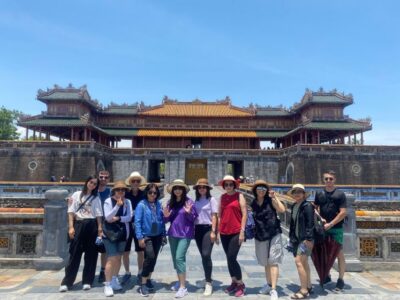
You’ll visit Ngo Mon Hue, built in 1833 during the reign of King Minh Mang. It is more than an impressive facade. It was used as a ceremony platform for key events, which means it is tied to public ritual, not just royal residence life.
Next, you’ll see the Flag Tower (Ky Dai Hue), located in Nam Chanh fortress. Even if you have never studied Vietnamese imperial history, you will understand what it was for: it was where the royal court hung its flag. That small detail helps you read the whole complex like a system, where architecture served court communication and ceremonial movement.
If you care about photos, these early stops are genuinely useful. You get clear photo windows at the places where visitors naturally want pictures, but the guide also connects the views to what they represented in court life.
Thai Hoa Palace: coronations that explain the whole court

One of the strongest parts of the tour is the focus on Thai Hoa Palace. It sits in the Imperial Citadel area and is tied to coronations, specifically the reigns associated with the 13 Nguyen kings.
When you’re standing in the palace area, it can be easy to think of a temple like a static object. Here, the guide turns it back into an event space. The palace becomes a timeline anchor, helping you remember who ruled and why that mattered for what you are seeing elsewhere in the citadel.
This is also where the tour’s theme about court life clicks. Once you understand coronation space, it gets easier to interpret the surrounding structures as parts of a controlled world. That makes the rest of your walk feel more connected and less like a list of buildings.
More hours inside the Citadel walls
- From Da Nang/Hoian/Hue: Hue Imperial City Full-Day Tour★ 4.8 · 295 reviews
- Hue Imperial City Walking Tour: Citadel & Forbidden City★ 4.8 · 245 reviews
- Hue Imperial Citadel, Tombs, Perfume River Boat Tour & Van★ 4.8 · 76 reviews
- Hue Imperial City and Forbidden City Walking Private Tour★ 4.9 · 42 reviews
- Chan May Port : to Golden Bridge/Imperial City/Hoi An Town★ 5.0 · 41 reviews
The imperial “front yard”: Hue Historic Citadel, Nine Urns, and the Mieu

After the major coronation anchor, the tour keeps you moving through the imperial layout in a way that supports your mental map.
You stop near the Hue Historic Citadel area for guided walking and photo moments. Then you reach Nine Dynastic Urns (Cửu Đỉnh Huế), commissioned by Emperor Minh Mang in 1835. These urns are not random decoration. They add to the formal front composition of the complex, which helps you understand why the court cared about symmetry, ceremony, and controlled sightlines.
From there, you go to The Mieu Temple (Thế Miếu Huế). This is dedicated to worshiping 10 Nguyen kings, which is a meaningful contrast to the broader talk of the royal line. That difference matters. It shows you that the court’s relationship to rulers was not only political. It was religious and ceremonial too.
If you like history that gives you “why this place exists,” these stops deliver. You end up looking at the architecture with purpose in mind instead of just admiring it.
Forbidden Purple City: restricted access, power, and privacy
The tour includes the Forbidden Purple City (Tử Cấm Thành Huế), reserved exclusively for the king and royal family. Even if you only glance at it from allowed viewing areas, the idea is clear: access was restricted for non-duty officials and civilians.
That single point, restricted access, helps you understand the court hierarchy quickly. You are not just seeing walls and rooftops. You’re seeing the physical version of boundaries: who belonged where, and who did not.
This is also where the tour’s “court secrets” angle starts to feel real. The harem is mentioned as part of what you will hear about during the walking experience, and the guide typically uses the restricted spaces to explain why certain areas were kept private.
This is a good section for curious travelers. If you enjoy “how did daily life work behind the scenes” rather than only dates and names, you’ll likely enjoy this part the most.
Palaces for rulers and the queen mother: Dien Tho and Kiến Trung

Two palace experiences give the tour a nice balance: one rooted in traditional imperial style, and one with European influences.
You visit Dien Tho Palace (Cung Diên Thọ), a large-scale project known for intricately carved details and an elegant style. It is especially well-preserved in the main hall. The tour frames it as a key royal space, and it is also described as the queen mother’s residence, which adds an emotional and social layer to what you’re seeing. It’s not only about the king. It’s about the power structures around him.
Then you reach Kiến Trung Palace (Điện Kiến Trung), built in 1923 by Emperor Khai Dinh. What makes this stop fascinating is the design contrast. Unlike many traditional Vietnamese buildings around it, Kiến Trung Palace was designed in a European style, mixing elements of Italian Renaissance and French classicism.
This kind of architectural mix can be confusing if you treat it as random. With a guide, it becomes a clue about the era’s influences and the ruler’s ambitions. You end up understanding the palace not only as a residence, but as a statement.
Duyet Thi Duong and the imperial leisure stops

Not every important moment in an imperial court was ceremonial. That’s why the Duyet Thị Đường Royal Theater (Duyệt Thị Đường) stop feels like a smart change of pace.
You’ll hear how it was one of four theaters constructed during the Nguyen dynasty, and it is described as the oldest preserved theater from that period. Even if you are not thinking about performing arts, this stop helps you picture the court beyond formal ceremonies.
The tour also includes garden and pavilion moments that keep the walk interesting. You may visit places like Thiệu Phương Garden and Thai Binh Pavilion, plus stops such as Hien Lam Pavilion. These are the spots where the guide’s interpretation matters most. Without guidance, you might treat them like scenic breaks. With guidance, they become part of how the court structured daily life, display, and movement through the complex.
If you like taking photos, these are often easier to enjoy without rushing. They give you space to look up at details, then step back for a wider view.
Timing, pace, and how the 150 minutes feels on your feet

This walk is built to fit an approximately 150-minute window, with typical guided time per stop. That structure helps you see the main highlights without getting stuck in one area too long.
At the same time, you are moving between multiple major points. I’d plan this tour as a centerpiece activity for half a day, not a quick add-on. If you stack it with other citadel sights, leave enough buffer time afterward so you can revisit any section you felt drawn to.
One practical tip: bring a little patience for photo moments. Some highlights, like Ngo Mon Gate and the theater areas, naturally attract camera time. If you keep your pace relaxed and let the guide finish the story before you rush for a shot, the experience gets more satisfying.
Price and value: what $15 buys, and what it does not

At $15 per person, this tour can be great value because you’re paying for an English-speaking guide and guided context across the Imperial Citadel area. You also get bottled water and local insurance included, which helps on a walking tour where you do not want to think about small logistics.
The part to watch is that entrance tickets are not included. That means your budget should treat $15 as the guided portion only. If you’re comparing options, this is the key math: $15 plus whatever the site requires for entry on the day you go.
Also note that pickup is optional, with a driver who can pick up and drop off at the hotel reception lobby. That can be worth it if you do not want to navigate the Cua Ngan meeting area on your own.
Private group availability is another value lever. If your group prefers questions, slower pacing, or more time at the places that catch your eye, private can feel less like a rushed tour and more like a custom history walk.
Who this Hue Imperial Citadel tour is best for
I think this works especially well for you if:
- You want a guided way to understand Nguyen dynasty power, not just admire buildings
- You care about the human side of the court, including the harem secrets angle
- You like your history tied to specific places you can point to while you learn
It’s also a strong match for first-time visitors. Hue’s imperial complex is big, and without guidance you can miss the story threads that connect the architecture.
If you already know a lot and prefer to wander independently, you might feel boxed in by a planned route. But even then, the focus on places like Thai Hoa Palace, the Forbidden Purple City, and Kiến Trung Palace is the kind of structure that can refresh your understanding quickly.
Should you book this Hue Imperial Citadel walking tour?
If you want Hue Imperial City to feel clear, not chaotic, I’d book it. The biggest reason is simple: you get a guided line through major palace spaces, including the coronation story, the restricted royal areas, and the queen mother residence, plus the architectural surprise of Kiến Trung Palace’s European mix.
Choose it if you value an English guide and a human pace, especially if you like asking questions. Just budget for entrance tickets separately, and you’ll be in good shape.
If your goal is to learn the court and why the architecture was built the way it was, this is one of the best ways to do it in a half-day walk.
FAQ
How long is the Hue Imperial Citadel walking tour?
The tour lasts about 150 minutes (roughly 2 to 2.5 hours).
What language is the guide?
The guide is English-speaking.
Where do I meet the guide?
You meet at Cuu Than Cong in Cua Ngan (Nine Holy Cannons). The guide will hold a welcome sign with your name.
Are entrance tickets included in the price?
No, entrance tickets are not included.
Does the tour include pickup from my hotel?
Pickup is optional. A driver can pick you up and drop you off at your hotel reception lobby.
Is tipping included?
Tipping is not included.
More Tour Reviews in Hue Vietnam


More Time Inside the Citadel


More Days Up in Hue
Just added around Hue Vietnam





Hue Imperial City Tours, compared.
 ★ 4.9Hue Customizable Tour with Imperial Citadel & Forbidden CityFrom $12937 reviews
 ★ 4.7Da Nang/Hoi An: Hue Imperial City via Hai Van Pass & LunchFrom $9753 reviews
 ★ 5.0Hue: Imperial City Walk, Motorbike Tour & Private Car OptionsFrom $7732 reviews
 ★ 5.0Hue City and The Citadel via Hai Van Pass Daily Small Group TourFrom $43362 reviews
 ★ 5.0Hue Citadel tour by authentic Train via Hai Van Pass from Da NangFrom $46337 reviews
 ★ 4.8From Da Nang/Hoian/Hue: Hue Imperial City Full-Day TourFrom $31295 reviews
 ★ 5.0Hue Imperial City Walking Tour: Citadel & Forbidden CityFrom $9280 reviews
★ 4.8Hue Imperial City Walking Tour: Citadel & Forbidden CityFrom $11245 reviews
★ 5.0Hue Imperial City Walking Tour: Citadel & Forbidden CityFrom $9280 reviews
★ 4.8Hue Imperial City Walking Tour: Citadel & Forbidden CityFrom $11245 reviews
Browse the lists this tour appears in