

REVIEW · HUE IMPERIAL CITY TOURS
Hue Imperial City and Forbidden City Walking Private Tour
Hue’s gate maze makes history walkable. This Hue Imperial City private tour threads you through key spaces of the Nguyen Dynasty, with an English guide who explains what everything meant and who was allowed to go where.
I love how guides like Nhi, Austin, and Ha make the rules of court life feel understandable, not just dates on a page. I also love the contrast between Duyệt Thị Đường (the oldest preserved Nguyen theater) and the recently restored Kiến Trung Palace, where you can see history literally rebuilt after collapse.
One thing to budget for: the Imperial City entrance ticket is not included, and you’ll buy it on the spot (200,000 VND per adult). So bring cash VND and plan a little time for that moment at the start.
Key points
- Meet at the Nine Holy Cannons (Cửu vị thần công), cast in 1803, near the Ngan Gate
- English guide plus bottled water for a smooth private walk through Hue’s core royal spaces
- Duyệt Thị Đường Royal Theater as the oldest preserved theater from the Nguyen era
- Kien Trung Palace restored in 2024, showing Asian and European architectural mix
- Nine Dynastic Urns commissioned by Minh Mang (1835), with 162 carved images across 9 bronze urns
- Finish at Cửa Hiển Nhơn, so your walk ends on the Imperial City side
Over the pass and into the imperial city
- Hue Customizable Tour with Imperial Citadel & Forbidden City
★ 4.9 · 937 reviews - Hue :Exploring Royal City with Multi Options and Dragon Boat
★ 5.0 · 675 reviews - Hue City Tour Full Day – Group Tour
★ 4.7 · 518 reviews - From Hue: DMZ Tour with Vinh Moc Tunnels and Khe Sanh Base
★ 4.9 · 503 reviews
Entering Hue Imperial City at the Nine Holy Cannons (and why it matters)

Your tour starts at the bronze-cannon area near the Ngan Gate, where your guide waits with an A4 paper showing your name. It’s a small detail, but it helps you avoid the classic start-of-tour chaos, especially in a place with lots of gates, walls, and similarly named spots.
Those “Nine Holy Cannons” (Cửu vị thần công) are more than a photo stop. They’re described as a precious bronze work cast in 1803, and that date is a big clue. The Nguyen court did not treat power as something theoretical. They built it, fired it, displayed it, and used it to organize access and authority.
This is a private group experience, so the pace stays human. Expect a mix of short walks and brief photo stops, with guided explanations threaded in as you move. You’re also covered for basic needs with bottled water included, which matters in Hue when the weather swings from sunny to rainy without warning.
Flag Tower and Noon Gate: the court’s control system in stone

After the cannons, you head toward the Flag Tower (Kỳ Đài Huế). The guide uses the location well, pointing out how it sits in the heart of the Hue Citadel’s south face and functioned as the flag-bearing site for royal court ceremonies. Even if you know nothing about imperial architecture, you’ll start to notice the design logic: sight lines, central authority, and visibility.
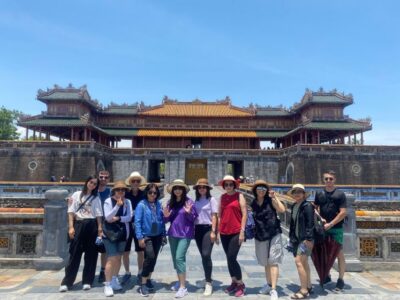
Then comes Cua Ngo Mon, the Noon Gate area. This gate was built in 1833 and reserved for the king, plus it was used to welcome envoys. In other words, this is where politics met spectacle. You can stand there and understand that the Nguyen court ran on ceremony, not just government paperwork.
If you pay attention to the guide’s explanations, the nearby structure called Ngu Phung Pavilion (Lầu Ngũ Phụng) also clicks into place. It’s described as an ironwood frame with 100 pillars, sitting above the gate area. That detail is the kind that makes a walking tour worth paying for. Without the interpretation, it’s easy to see impressive architecture and miss the “why.”
One more orientation point your guide should help you grasp is the Forbidden Purple City concept. It was reserved for the king and royal family, while mandarins and civilians were not allowed close. You may not be able to “experience” that restriction like an imperial insider, but you will understand the layout behind the rules, which is the real payoff.
Thái Hòa Palace: where coronations for 13 Nguyen kings happened
Next, you move into the Imperial Citadel area and land at Thái Hòa Palace (Điện Thái Hòa). This is the coronation place of 13 Nguyen kings, and that fact alone gives the site instant weight. It’s not just a big building. It’s a repeated stage for leadership transitions across generations.
In my view, this is where the tour becomes more than a sequence of monuments. When your guide connects the palace to the long Nguyen reign period, the city layout stops feeling like random grandeur. You start to understand how power was staged, repeated, and legitimized in physical space.
You’ll typically spend a focused stretch here for photos, walking, and guided context. The quick rhythm works well because Thái Hòa is visually impressive, but it can also overwhelm you if you’re trying to read it alone. With a guide, you get a few key interpretive anchors, then you can actually enjoy standing in the courtyard rather than trying to decode everything at once.
More hours inside the Citadel walls
- From Da Nang/Hoian/Hue: Hue Imperial City Full-Day Tour★ 4.8 · 295 reviews
- Hue Imperial City Walking Tour: Citadel & Forbidden City★ 4.8 · 245 reviews
- Hue Imperial Citadel, Tombs, Perfume River Boat Tour & Van★ 4.8 · 76 reviews
- Hue Imperial City and Forbidden City Walking Private Tour★ 4.9 · 42 reviews
- Chan May Port : to Golden Bridge/Imperial City/Hoi An Town★ 5.0 · 41 reviews
Duyệt Thị Đường Royal Theater and the pause for royal culture

Duyệt Thị Đường (Duyệt Thị Đường Royal Theater) is one of the four theaters built during the Nguyen dynasty, and it’s also the oldest preserved theater. That combination is powerful: the court did not just worship in temples or govern from palaces, it also performed culture in dedicated venues.
What I like about including the theater in this walking route is that it breaks the “palace only” rhythm. It gives you a different angle on royal life, showing that the Nguyen court invested in how culture looked and sounded, not just how it ruled.
Afterward, the tour shifts to royal leisure with Thiệu Phương Garden (Vườn Thiệu Phương), built in 1828. This garden is described as one of the typical royal gardens of the Nguyen dynasty. It’s a good reality check too. If you only focus on ceremonies and power, you might miss how carefully the court planned comfort, pace, and aesthetics.
Then you’re taken to the Thai Bình Pavilion (Thái Bình Lâu), built from 1919 to 1921, described as a place for the king to rest and relax. This “rest space” detail is important. It reminds you that the royal system changed over time, not everything stayed frozen in the 1800s. The guide’s story helps you connect late Nguyen-era spaces to the older ceremonial core.
Kiến Trung Palace rebuilt in 2024, and the era when designs changed

The tour includes Kiến Trung Palace (Điện Kiến Trung), built in 1923 with a combination of Asian and European architecture. The story gets even more interesting because the palace completely collapsed and was restored in 2024.
This stop is one of the most valuable for people who like their history grounded in the present. You’re not just looking at “old stuff.” You’re looking at how the site’s meaning is continuing to evolve because restoration is ongoing. That also helps explain why you might see modern work alongside older patterns in this part of the complex.
The guide typically sets you up with the context quickly, so you can appreciate the architectural mix without getting lost in too many technical terms. You get enough time for a close look and photos, but you’re not stuck in one spot long enough to make the rest of the walk feel rushed.
Cung Diên Thọ and Hưng Tổ Miếu: power stored in family and worship

Cung Diên Thọ is the Queen Mother’s residence, and the tour describes it as large scale with exquisitely carved details and an elegant style. This is a great stop for understanding that royal authority wasn’t only male or only tied to the throne. The queen mother’s residence signals influence inside the family structure, plus it shows how craftsmanship and status were displayed.
A short walk later, you reach Hưng Tổ Miếu (Hưng Tổ Miếu), described as a temple dedicated to worshiping the 10 Kings of the Nguyen dynasty. This is the place where the “dynasty timeline” the guide talks about becomes physical. Instead of just imagining ancestors and legitimacy, you see a space built for veneration tied directly to named kings.
For me, these two stops work as a pair. Residence plus worship gives you a fuller picture of what the Nguyen system valued. It wasn’t only about administration. It was also about lineage, reverence, and continuity.
Nine Dynastic Urns and Hiển Lâm Các: the city as an open-air classroom

Nine Dynastic Urns (Cửu Đỉnh Huế) are commissioned by Emperor Minh Mang in 1835. The total is nine bronze urns with 162 images cast and carved across them. That’s the kind of number you might forget if you’re reading it on a sign. With a guide, you learn what to pay attention to, so the urns feel like a planned visual program rather than decorative metalwork.
This stop tends to be short but memorable. You get a guided explanation, then time to look for patterns in the carvings and understand how the court used images to communicate ideas across distance and generations.
The tour ends with Hien Lam Pavilion (Hiển Lâm Các), built in 1821 to 1822. It’s described as the place where emperors had epiphanies. That wording is poetic, but the point is practical: this part of the complex was meant for reflection, not just public ceremony.
From there, the walk finishes at Cửa Hiển Nhơn. Ending at a gate matters more than you might think. It’s often easier to regroup your plans, hop into a cab, or continue exploring the area when you’re not stuck wandering back the way you came.
Price and ticket reality: what you pay, what you still need

The tour price is listed at $23 per person for about 150 minutes, delivered as a private walking experience with an English-speaking guide and bottled water. The big value here is not that the sites are “cheap,” it’s that you’re buying interpretation for a short, efficient route.
Hotel pickup and drop-off is included only if you choose that option. If you don’t select pickup, you’ll just meet at the designated cannon area.
Entrance tickets are not included. The base Imperial City ticket is 200,000 VND per adult. There are also combo options that can help if you plan to add nearby tombs. The info provided includes:
- 420,000 VND per adult for the Imperial City with 2 tombs
- 530,000 VND per adult for the Imperial City with 3 tombs, valid for 2 days
Here’s how I’d think about the choice. If you have limited time and you want the story, a private guide for the core Imperial City makes sense even with ticket add-ons. If you know you want more tomb stops across multiple days, the combo ticket options become your friend. Also, the guide helps you buy tickets, and the advice is to prepare cash in VND to avoid extra queuing time.
So yes, you’ll spend more than the $23 once tickets are added. Still, the tour can be excellent value if you want to understand what you’re looking at, not just collect stamps on a map.
Who this Hue walking tour fits best (and who might skip it)

This tour is a strong match if you:
- want a private pace without feeling like you’re racing
- care about how the Nguyen court worked, not just what buildings look like
- like short stops with guidance, where you get a key idea then a photo moment
- are visiting Hue with limited time and want a focused slice of the Imperial City core
It might be less ideal if you:
- want a long, wandering self-guided day with no structure
- prefer to spend extra hours beyond the core stops listed here
- hate paying for interpretation and can read Vietnamese signage well enough to go fully independent
Practical tips I’d use before you go

Hue can be hot, and it can also rain unexpectedly. One guide experience shared in the tour feedback mentioned preparation with ponchos and a helmet during heavy rain, which tells me the team takes weather seriously. You should still bring your own light rain protection, plus wear comfortable shoes since this is real walking across the citadel grounds.
Bring cash VND for tickets. Even if your guide helps, having cash ready makes the start smoother.
For photos, remember many stops are built around short photo windows. If you have specific shots in mind, tell your guide at the beginning. They can steer you toward better angles in the time you have.
If English clarity varies with the guide (this happens anywhere, not just here), the best move is simple: ask for slower repetition when something matters to you. The whole point is to get your questions answered while the space still makes sense.
Should you book this Hue Imperial City private walking tour?
If you like the idea of turning gates, palaces, gardens, and ceremonial spaces into a clear story, I think this is an easy yes. You get a compact route, English interpretation, and standout stops like Duyệt Thị Đường, Kiến Trung Palace restored in 2024, and the Nine Dynastic Urns linked to Minh Mang in 1835.
Book it especially if you’re the kind of traveler who reads a sign, nods, then wonders what you actually should notice. A good guide here helps you see the patterns: how access was controlled, how coronations and family authority were displayed, and how the dynasty left instruction across stone and bronze.
If your budget is ultra tight, you could try going on your own and reading quietly. But if you want Hue to make sense fast, and you want the Nguyen-era logic behind the walls, this private tour is one of the most practical ways to do that in a short time window.
FAQ
Is the Imperial City entrance ticket included in the tour price?
No. The Imperial City entrance ticket is not included, and it is listed as 200,000 VND per person.
How long is the tour?
The duration is listed as 150 minutes.
Is this an English-speaking tour?
Yes. The guide is English-speaking.
Where do we meet the tour guide?
Meet at the 4 Bronze Cannons area near the Ngan Gate (Cửa Ngăn). The guide will be holding an A4 paper with your name.
Is it a private group tour?
Yes. It is a private group tour.
Does the price include bottled water?
Yes. Bottled water is included.
Do we get hotel pickup and drop-off?
Hotel pickup and drop-off are included only if you select the option.
What about food and drinks?
Food and drinks are not included.
What if I need to cancel?
Free cancellation is offered up to 24 hours in advance for a full refund.
Are there combo ticket options besides the single Imperial City ticket?
Yes. The provided options include a combo at 420,000 VND per adult for the Imperial City with 2 tombs, or 530,000 VND per adult for the Imperial City with 3 tombs (valid for 2 days).
More Tour Reviews in Hue Vietnam


More Time Inside the Citadel


More Days Up in Hue
Just added around Hue Vietnam




Hue Imperial City Tours, compared.
 ★ 4.9Hue Customizable Tour with Imperial Citadel & Forbidden CityFrom $12937 reviews
 ★ 4.7Da Nang/Hoi An: Hue Imperial City via Hai Van Pass & LunchFrom $9753 reviews
 ★ 5.0Hue: Imperial City Walk, Motorbike Tour & Private Car OptionsFrom $7732 reviews
 ★ 5.0Hue City and The Citadel via Hai Van Pass Daily Small Group TourFrom $43362 reviews
 ★ 5.0Hue Citadel tour by authentic Train via Hai Van Pass from Da NangFrom $46337 reviews
 ★ 4.8From Da Nang/Hoian/Hue: Hue Imperial City Full-Day TourFrom $31295 reviews
 ★ 5.0Hue Imperial City Walking Tour: Citadel & Forbidden CityFrom $9280 reviews
★ 4.8Hue Imperial City Walking Tour: Citadel & Forbidden CityFrom $11245 reviews
★ 5.0Hue Imperial City Walking Tour: Citadel & Forbidden CityFrom $9280 reviews
★ 4.8Hue Imperial City Walking Tour: Citadel & Forbidden CityFrom $11245 reviews
Browse the lists this tour appears in