

REVIEW · HISTORICAL TOURS
Da Nang Epic History Tour by Cham Museum & Tasty Cuisine/Cafe
Da Nang has a way of layering time on your footsteps. This 3-hour walk ties together the Cham Museum, Buddhism at Long An Pagoda, and then the city’s more recent stories along the Han River, with food stops built in.
I especially like how the tour uses an English-speaking guide with a background as a historian, so you do not just look at pretty things, you learn what you are seeing and why it mattered. I also like the practical “eat and sip” pacing, you get pho plus coconut coffee or salt coffee, plus optional rice wine tasting depending on the option you choose.
One thing to consider: there is no pickup or drop-off, and it is a walking-focused route. If you want long museum browsing time on your own schedule, this is not that kind of slow day.
Key points to know before you go

- Cham Museum first: Hundreds of antique Hindu stone sculptures from the 7th-14th centuries, tied to the Cham Pa Kingdom and My Son.
- Long An Pagoda stop: You learn how Mahayana Buddhism shows up in local belief and daily life through stories, not a lecture.
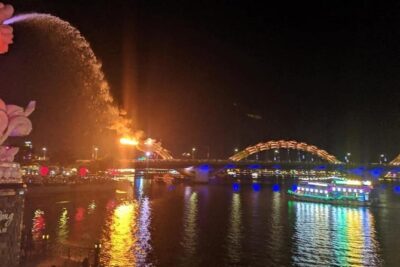
- Dragon Bridge and the Han River: The 666m Dragon Bridge anchors views, and the river walk connects to Da Nang’s Vietnam War era role.
- Local nicknames: Da Nang Cathedral Church is known by locals as Chicken Church, a small detail that makes the place feel lived-in.
- Food that fits the route: Pho at the Hanoi Quarter corner inside Da Nang, plus coconut or salt coffee at the end.
- Private by group: It is private, so your group stays together, with a mobile ticket and group discounts.
More of the city itself, between the beach and the bridges
- Da Nang: Lady Buddha, Marble Mountains, and Am Phu Cave Tour
★ 4.7 · 3,373 reviews - From Da Nang/Hoi An: Golden Bridge Ba Na Hills Full-Day Tour
★ 4.7 · 1,737 reviews - Da Nang: Han River Local Cruise by Night
★ 4.1 · 1,152 reviews - Da Nang: Golden Bridge, Lady Buddha, Marble Mt & Am Phu Cave
★ 5.0 · 1,147 reviews
A 3-hour loop that stitches Da Nang into one story

This tour works because it moves in chapters. You start with ancient art, then shift to religion and daily rhythms, and finally land in the more recent historical world of Da Nang, seen through architecture and river views. The whole thing is paced at about 3 hours, which is a sweet spot if you want meaning without losing half a day.
At $29 per person, the value comes from what is bundled. You are not just paying for a walk. You get a historian-style English guide, Cham Museum entrance tickets, and included tastings like pho and coffee. For many visitors, those inclusions are what make a guided tour feel worth it instead of feeling like you are just buying logistics.
The tour ends back at the meeting point, so you do not have to worry about backtracking across town. Still, do plan for walking and bring comfortable shoes, because you are moving between several city landmarks.
Cham Museum, why these Hindu sculptures matter
The day opens at the Da Nang Museum of Cham Sculpture at Số 02 Đ. 2 Tháng 9, Bình Hiên, Hải Châu, Đà Nẵng. The museum focus is specific and powerful: it is presented as the world’s largest collection of Hinduism sculptures, with hundreds of antique stone statues from the 7th-14th century through the Cham Pa Kingdom era.
What I like about starting here is that it gives you a historical baseline fast. If you are going to see later religious sites, markets, and colonial-era buildings, the Cham world helps you understand the older layer of central Vietnam that still shapes how people think about heritage.
You will also hear the link between the Cham Pa Kingdom and the My Son relics, which are part of Vietnam history tied to Hindu cultural traditions. Even if you never make it out to My Son on a separate trip, this stop helps you connect the dots so that anything you later read or see does not feel random.
Practical note: museum time can feel concentrated if you are photo-happy, but the tour is built to keep momentum. If you want to linger at a single sculpture longer than the group pace allows, you might enjoy taking a few quick photos first, then returning with your own curiosity once the main walking portion ends.
Long An Pagoda and the way Buddhism shows up locally
Next, you move to Long An Temple (the tour also calls it Long An Pagoda in the overview). This stop shifts from ancient sculpture to living belief. The focus is Mahayana Buddhism, plus local practice and the way those beliefs influence everyday life in Da Nang.
I like how the tour frames religion as a lived thing, not just a stop for incense photos. The stories you hear are aimed at showing why locals behave the way they do and how spiritual ideas show up around ordinary routines.
This is also the kind of stop that makes the city feel less like a checklist. A pagoda visit often becomes meaningful when you understand what you are looking at, like symbols, rituals, or simple habits you might otherwise overlook.
If you are sensitive to crowds or prefer quieter spaces, try to keep your expectations realistic. Temple areas in popular cities can get busy, especially around visiting times, so go slowly and give yourself room to adapt.
More of the older story around here
- Hue Culture & History Day Tour – Departing Hoi An or Da Nang★ 5.0 · 26 reviews
- My Son Sanctuary And Hoi An Heritage Full-day Tour★ 4.5 · 25 reviews
- Da Nang: Full-day My Son Sanctuary And Hoi An Heritage Tour★ 4.8 · 21 reviews
- Da Nang Epic History Tour by Cham Museum & Tasty Cuisine/Cafe★ 5.0 · 15 reviews
- Da Nang War Tour History: Spanish-French Attack to American Base★ 5.0 · 13 reviews
APEC Park, Dragon Bridge, and the Han River viewpoint

From Long An, you head toward APEC Park before arriving at the main photo magnet: Dragon Bridge. The bridge is described as iconic, with a length of 666m, and it is hard to miss. Standing near it, you start to understand why Da Nang branded itself around big, modern landmarks.
But the best part of this section is the context. As you walk along the Han River, you are shown the idea that Da Nang was a major military base, and you are guided to see how American constructions built for the Vietnam War era influenced the city’s landscape and memory, especially before 1975.
You are not walking into a history lecture. Instead, you are connecting history to place. That matters, because the Han River is not just scenery, it is a line where you can imagine the city’s past moving through the same spaces you are using now.
This is also a good stretch to reset your senses. After museum detail and temple symbols, the open air helps. Just keep an eye on the weather and the sun, because river walks can heat up quickly.
Chicken Church and what you notice when locals name things

Then comes Da Nang Cathedral Church, which locals nickname Chicken Church. That kind of local naming is a small detail, but it signals something important: the site is not only for visitors. It has a relationship with everyday neighborhood language.
I find that nicknames change how you look. Instead of treating the cathedral as a distant “old building,” you start scanning for the features locals point to in their shorthand. Even if you cannot get the full story from your own reading, the guide’s explanation helps you interpret the nickname as part of local culture, not just a funny label.
This stop is also a useful counterpoint to the earlier temple and museum sites. You end up with three different kinds of sacred space in one morning style tour, which gives you a fuller picture of the city’s historical layers.
Pho at the Hanoi Quarter and Han Market, French buildings and Chinese community

After the landmarks, the tour turns practical with a food stop: pho at the corner described as the Hanoi Quarter inside Da Nang. This is where you stop thinking like a tourist historian and start thinking like someone who wants to eat well in a new city.
Then you head to Han Market, called the biggest market in central Vietnam and described as built by the French during the colonial period. The guide ties the buildings to the people connected to them, especially the Chinese community living in Vietnam.
This is one of those stops where the value is in how you look. Markets can be noisy and chaotic if you treat them like a souvenir hunt. But with a guide, you start spotting patterns: how goods group together, how community networks show up through products and food, and how colonial-era planning shaped what the space became.
Even if you do not plan to shop much, Han Market is still worth it for the atmosphere and the historical angle. If you do want small purchases, keep your budget in mind and avoid getting pulled into anything that is not clearly priced.
Coconut coffee, salt coffee, herbal green tea, and optional rice wine

The tour wraps up with tasting. You get coconut coffee or salt coffee, described as some of the best coffee in Vietnam, with stories that connect the tastes to Vietnam’s past and the way wars affected the sleep and lives of earlier generations.
That blend of food and memory is the point here. Coffee is not just a drink, it becomes a doorway to understanding how people cope and continue. And because it is your final stop, it is a satisfying wind-down after a walking-heavy few hours.
Also included is Ha Noi herbal green tea at Ha Noi corner. If you are choosing a particular option, you may also get rice wine distillery and tasting. The inclusion list makes it clear there are different tasting paths, depending on what you select, such as walking tour plus cafe tasting, or walking tour plus rice wine distillery.
Practical tip: taste slowly. Coconut coffee and salt coffee can be intense in different ways, so give yourself a moment before rushing into the next cup or snack.
Is $29 worth it for a historian-led Da Nang loop?
For a private tour at $29 per person with a guide, museum tickets, and included food and drinks, the value is strong, especially if you would otherwise pay separately for tickets and try to assemble a route on your own.
Here is what you are really buying:
- A clear route across Da Nang’s key layers of history.
- Access to the Cham Museum without figuring out tickets and timing.
- Food inclusions that prevent the “what do we eat now?” problem.
- An English-speaking guide with historian background, which helps prevent the trip from turning into random sightseeing.
Two logistics notes matter for your planning. First, there is no pickup or drop-off, so you need to make it to the museum meeting point yourself. Second, the tour is weather dependent, so plan to have a flexible mindset. If the day is not cooperating, you may be offered another date or a full refund.
It is also worth knowing that this tour is commonly booked about 60 days in advance on average. If your schedule is fixed, you are smart to lock it in earlier rather than later.
Should you book this Da Nang Epic History Tour?
You should book it if you want a guided, story-based overview of Da Nang that mixes ancient Cham sculpture, Buddhism at Long An, modern landmark views from Dragon Bridge, and a realistic look at how war-era history connects to the river.
You might skip it if you hate walking, you want lots of free time to roam museums without timing, or you dislike guided groups at multiple stops. Also, if you already have a deep interest in one niche area, like only Cham art or only war history, you may want to pair this with a more focused add-on.
My take: for most people doing Da Nang as part of a bigger Vietnam trip, this is a tidy way to get context fast, then eat something good while it is still fresh in your head.
FAQ
How long is the Da Nang Epic History Tour?
It runs for about 3 hours.
Is this tour private?
Yes, it is private, and only your group participates.
What is included with the ticket price?
Included are Cham Museum entrance tickets, a Chicken or Beef pho, coconut coffee or salt coffee (if that option is selected), Ha Noi herbal green tea at Ha Noi corner, and (if selected) a rice wine distillery and tasting. It also includes an English-speaking guide with historian background and a private certificate.
Where does the tour start and end?
The tour starts at Da Nang Museum of Cham Sculpture and ends back at the same meeting point.
Do I need to arrange transportation to the meeting point?
Pick-up and drop-off are not included, so you will need to make your own way to the start location. The meeting area is near public transportation.
What food and drink will I try?
You can expect pho, Ha Noi herbal green tea, and coconut coffee or salt coffee. Depending on the option you select, you may also try rice wine tasting.
Is there a mobile ticket?
Yes, the tour includes a mobile ticket.
Is free cancellation available?
Yes, there is free cancellation. You can cancel up to 24 hours in advance for a full refund.
What happens if the weather is bad?
The experience requires good weather. If it is canceled due to poor weather, you will be offered a different date or a full refund.
More Tours in Da Nang


More Tour Reviews in Da Nang

Still in Da Nang? Keep Going

Just added around Da Nang

Historical Tours, compared.
 ★ 5.0DMZ & Vinh Moc Tunnels – Private Historical Tour from HueFrom $80188 reviews
 ★ 5.0Hue Half-Day Motorbike Tour – Authentic Countryside of Vietnam, History, CultureFrom $36143 reviews
 ★ 5.0Heritage Adventure Private Tour by Electric CarFrom $1796 reviews
 ★ 5.0Vietnamese Cooking Class in Historical Hoi An RestaurantFrom $3358 reviews
 ★ 5.0Hue Food Tour: Central Vietnam Culinary Heritage (Small Group)From $3442 reviews
 ★ 5.0Hue Motorbike & Boat Tour to Countryside & Heritage SitesFrom $2035 reviews
 ★ 5.0Hue History & Hidden Spots: Curated City Tour with Local InsightsFrom $2427 reviews
 ★ 5.0Hue Culture & History Day Tour – Departing Hoi An or Da NangFrom $14826 reviews
Browse the lists this tour appears in